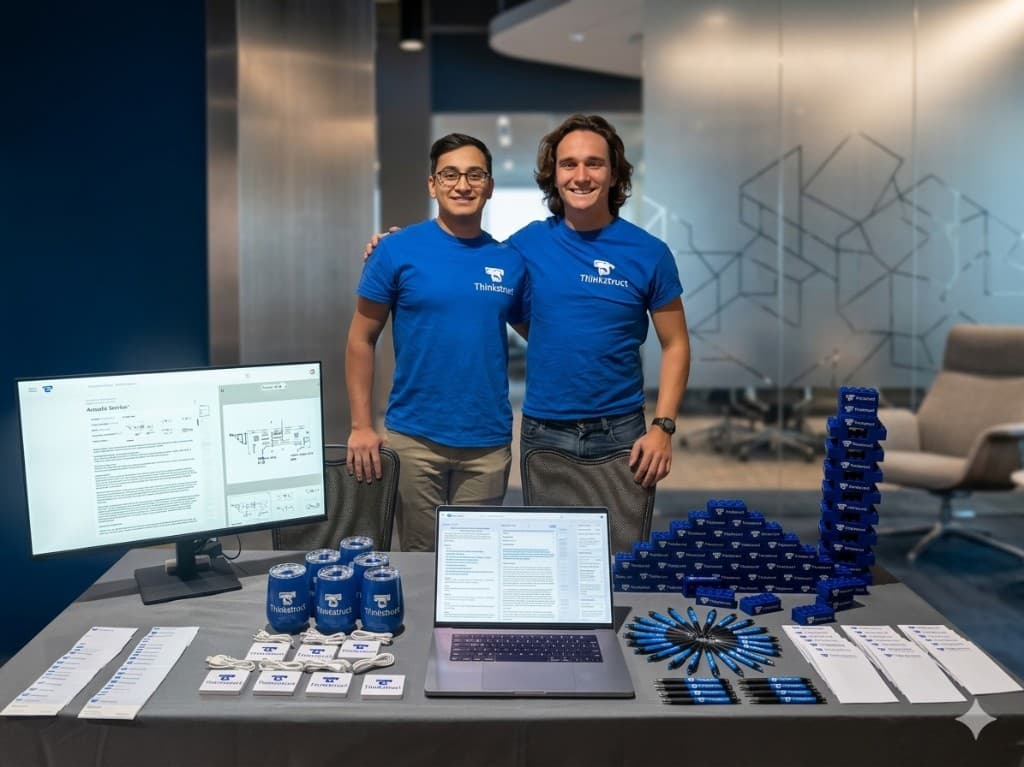
Thinkstruct was founded by two MIT roommates who spent four years working closely together, both on the varsity sailing team and hacking across a wide range of technical projects. Originally from Texas, they had known of each other before college, but it was at MIT that they developed a close, highly collaborative partnership.
Surrounded by research pushing the bleeding edge of innovation, the two friends saw the same recurring problem: literature review was slow, manual, and difficult to do well, causing research to get duplicated and collaboration to be missed. Identifying a small number of relevant papers among thousands required significant effort, and there was no reliable way to map or navigate the broader information landscape. They began focusing directly on this problem, building tools to systematically surface and organize the most relevant information.
This focus was reinforced by Julius's background in physics. After entering MIT intending to pursue experimental physics, he became involved in particle physics research at CERN. In that setting, the challenge of extracting meaningful and interpretable results from massive volumes of data was central. Later his research evolved to the intersection of physics and AI, focused on a 2022 collaboration between MIT's physics department and CSAIL to build the first open source, end-to-end framework to quickly build AI support agents for research. Then, transitioning fully into the AI space and leaving physics behind, Julius built mechanistic interpretability techniques for understanding model deception, culminating in work accepted to ICLR 2024.
Nicky took a complementary path. He was deeply involved in the MIT startup ecosystem from early on, with a clear focus on building companies. He worked at multiple startups during his time at MIT, including a team that went through Y Combinator, and was closely involved with the Martin Trust Center for Entrepreneurship. His experience gave him early exposure to company building, product development, and the realities of bringing technical ideas to market.
Together, they built the first version of Thinkstruct as a tool for academic literature review. Developed while still in college, the platform was adopted by over 200 researchers across institutions including MIT, Harvard, USC, and the University of Maryland. The team was admitted to the MIT delta v accelerator, named a finalist in the MIT $100K competition, and top of their MIT Sandbox cohort.
However, despite clear user interest, the academic market proved difficult to monetize. The core technology was strong, but the path to building a sustainable business in that space was unclear.
The turning point came at the MIT campus bar, where they spoke with a sailing alumni who was an experienced patent attorney. After understanding the system they had built, he pointed out a direct application to IP law: patent search and analysis involve identifying highly specific prior art within an extremely large and complex corpus, where missing a key reference can have major legal and financial consequences.
Following that conversation, the team pivoted. Shortly after graduating from MIT, they incorporated Thinkstruct and shifted their focus to patent search and analysis. The company raised its first round of funding soon after and began building its platform for legal and technical professionals.
Today, Thinkstruct applies modern machine learning and information retrieval techniques to patent law, focusing on improving the speed, accuracy, and reliability of prior art search and claim analysis. The company's approach is grounded in both technical depth and direct experience with the underlying problem: identifying the right information in environments where precision matters.